



Duncan Maclennan makes case for unifying council housing duties and resources at CIH’s Scotland Housing Festival
A professor of urban economics at the University of Glasgow has proposed that Scotland should move towards combined regional housing authorities to deliver housing services.
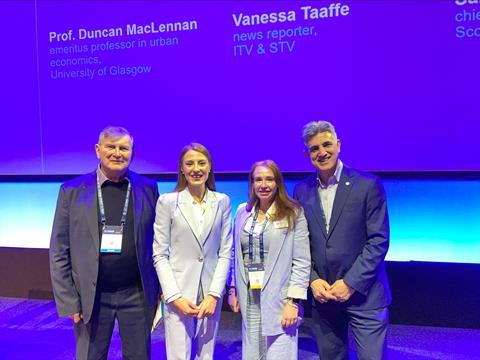
Speaking this morning at the Scotland Housing Festival, hosted by the Chartered Institute of Housing (CIH) in Glasgow, Duncan Maclennan argued this model would better serve the sector and government investment because “housing action at a strategic level is at a regional level.”
He said: “In England, they generated combined housing authorities so that housing is managed, or most of it, in Manchester or in the North East of England. Why don’t we have a combined housing authority? Do we need [several] housing authorities in the west of Scotland?”
Maclennan also suggested new affordable housing funding body More Homes Scotland should consider allocating grant funding on a regional basis.
The creation of the agency was confirmed by the first minister last month and is expected to start operating from 2027-28 and be fully functional in 2028-29.
The Greater Manchester Combined Authority and North East Combined Authority are ‘established mayoral strategic authorities’ with the ability to set the strategic direction of the Social and Affordable Homes Programme (SAHP) 2026–2036. Both have ‘strategic place partnerships’ with Homes England, which aim to empower local authorities to drive regeneration projects in line with local need and priorities.
Maclennan was a long-serving board member for the former national housing agency Scottish Homes, which was abolished in 2001 with its functions redistributed.
He said that sector talent within Scottish Homes was “squeezed our really quickly by the civil service” and warned against the same outcome for the new agency.
He added: “It must not just be moving a bit of the civil service into an executive agency so they will still do exactly what other bits of civil service tell them to do. That’s a disaster, in my view.
“I respect civil service tradition, but it has ways of going about business and it does not fully understand the housing system. You don’t understand how to change the system unless you’ve worked in it.”
He said that housing professionals from across the sector, including those working in housing associations, councils and the private sector, must be at the forefront of More Homes Scotland.
Michelle Mundie, chief executive of Argyll Community Housing Association (ACHA), said she is “not against” the idea of combined regional authorities but questions what the improved offer would be.
She said ACHA has a “really good relationship” with the local authority, describing it as “really supportive”, noting that other housing associations within the Argyll locality are “doing really well”.
However, she added that she does not think the introduction of a combined regional housing authority would harm engagement with housing providers.
Sharon Egan, head of housing at South Lanarkshire Council, said the possibility of different political parties leading different constituencies could impair the efficiency of such an approach, but highlighted the opportunities for partnerships with neighbouring councils.
Maclennan also called on the Scottish government to integrate housing policy into infrastructure policy, so regional housing and infrastructure funding and strategy are produced simultaneously.







No comments yet