
ECF and Hull Council look to turn brownfield land formerly used for city’s maritime industry into affordable and BTR flats
Hull City Council has submitted detailed plans for the first phase of an 850-home community along the River Hull.
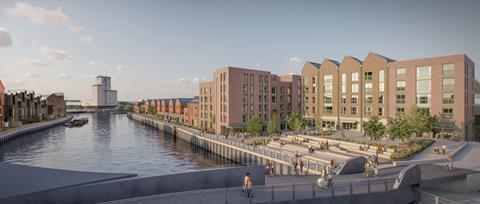
Phase one of East Bank Urban Village would deliver 37 townhouses and 78 apartments across two buildings, all affordable housing.
It would also include the landing for the Scale Lane Bridge on the eastern bank of the River Hull and the connection to the Trinity Buoy Shed, a heritage building that will be brought back into use as part of the scheme.
The masterplan was created with lead development partner English Cities Fund (ECF), a partnership between Homes England, L&G and Muse.
The hybrid application also includes outline plans for the wider neighbourhood, which will deliver more than 700 build-to-rent and affordable flats over the next 15 years, as well as shops, restaurants and leisure facilities.
Designed by Carey Jones Chapman Tolcher, the scheme also intends to revitalise the area around the Drypool Basin as a community space.
Located opposite Hull’s Old Town, the site is primarily occupied by surface parking and vacant brownfield land following the decline of the city’s maritime industry in the mid-20th century.
Feedback from local people during the consultation period last autumn included the need for more green community spaces, parking and traffic management and finding new uses for existing historical landmarks like the former Lock Keeper’s Cottage.
Raife Gale, senior development manager at ECF, said: “The council has an ambitious programme of regeneration which is already helping transform the city centre, as seen with the recently completed redevelopment of the Museums Quarter and Old Town, and we are using our knowledge and expertise in delivering complex schemes across the UK to help unlock the next phase of the city’s development.”
The project is supported by £9.8m in government-backed Levelling Up Partnership funding, which will underpin enabling works and early infrastructure delivery.
Delivery of the scheme is expected to be phased over four stages, with construction of phase one starting in 2027 and final completion of phase four anticipated in 2040.
Hull City Council is targeting 2,500 new homes in the city centre by 2040 as part of its local plan.





No comments yet