



More landlords resolved issues through redress before escalation in 2025/26
The Housing Ombudsman upheld a lower proportion of complaints made by social housing residents in 2025/26 compared with the previous year.
According to the watchdog’s latest annual review, 62% of complaints were upheld, down from 71%, as thousands more cases were investigated (see chart below).
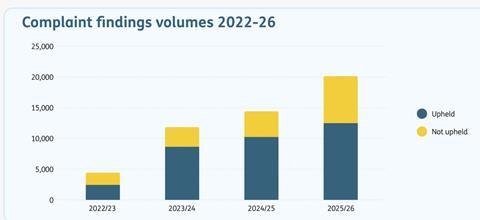
The ombudsman said the figures show improvement in complaint-handling by social landlords, with “more landlords resolving issues appropriately” before they escalated.
In total, 8,783 determinations were made in the year, with findings of no maladministration rising to 17% from 13%, while reasonable redress rose to 20% from 13%.
Severe maladministration determinations fell to 470 (2% of findings) from 714 (5%) the year before.
Meanwhile, the average amount of compensation per upheld case dropped from £947 to £703. Over 65% of compensation related to responsive repairs.
The ombudsman noted that the year’s complaint uphold rate reduction partly reflects a change it made to its protocol in October 2025. It now considers complaint handling in every case it investigates, rather than just when a resident raises complaint handling as a concern. However, even without this change, the watchdog said the uphold rate would still have fallen from 68% to 65%.
Responsive repairs had the highest maladministration rate of any category at 5%, with condensation, damp and mould accounting for 34% of repairs complaints and leaks making up 23%. The ombudsman upheld more than 75% of these complaints.
Windows, a new category in 2025/26, had the highest uphold rate among repairs complaints at 80% and a severe maladministration rate of 10%.
Housing associations performed better than local authorities, with complaint uphold rates of 59% an 72% respectively. The ombudsman said this is because housing associations resolve more issues through redress before escalation compared to councils.
The watchdog investigated almost twice as many complaints per 1,000 homes in London compared to outside of the capital, reflecting “specific challenges in London including overcrowding and aging homes”.







No comments yet