



Firms call for greater recognition of cost they face – including higher taxes implemented by current government
Built environment firms have broadly welcomed Andy Burnham’s ambitions on council housing and devolution but called for greater recognition of the funding pressures faced by the industry.
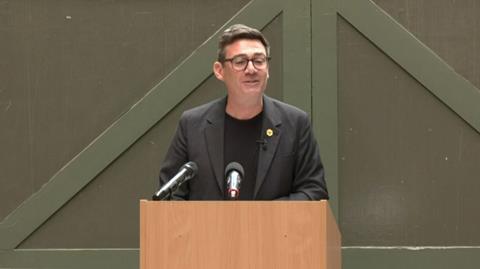
The prime minister-in-waiting said yesterday that he wanted to deliver the “biggest council house building programme since the post-war period” which would be overseen by a new outpost of Number 10 based in Manchester.
The new office, called Number 10 North, would also be tasked with devolving more powers across UK regions, including London, as part of a vision of to ensure “good growth in every postcode”.
Pocket Living chief executive Paul Rickard said it was “absolutely right” to focus on empowering regional mayors and local authorities as a means to support economic growth.
“This enhanced devolution of powers and focus on innovative place-first good growth, including large-scale regeneration and housing, forms part of the bold thinking that we need to see happen and it is very pleasing to see housing being directly linked to the success of the UK’s overall economic strategy,” Rickard said.
Gavin Smart, chief executive at the Chartered Institute of Housing, also said the speech had “rightly put housing at the centre of the national debate, recognising that a safe, secure home underpins people’s life chances and the country’s economic success”.
But he added that delivering large-scale council housebuilding “will require sustained investment and a whole-sector effort”.
RSM UK national head of social housing John Guest said the housebuilding sector would need to see “much more detail on what this looks like and how it might be delivered”.
“While affordable housing completions are increasing, there is an urgent need for significant government investment to meet the current supply targets, and with little fiscal headroom it’s currently unclear where funding for additional social housing would come from,” Guest said.
“Meanwhile, ongoing economic headwinds and cost pressures due to the Iran conflict are increasing the need for clarity and support for the social housing sector in the near-term.”
Building Cost Information Service (BCIS) chief economist David Crosthwaite said Burnham had set out “what he wants to build, but not who will build it, how it will be funded, or what would enable a significantly faster rate of delivery than the industry is currently achieving”.
“Notably absent was any acknowledgement of the near-term cost pressures facing businesses. Labour costs remain the primary driver of construction project costs, and the employer National Insurance increases introduced by the current government have added to the burden on supply chains,” Crosthwaite said.
However, Richard Caten, chief executive at planning firm Ardent, said that “if regions are given the powers, certainty and resources to bring forward critical infrastructure, they will be better placed to attract investment, unlock development and create long-term prosperity for communities across the UK.”
And Richard Frudd, senior director and head of Leeds at planning consultancy Quod, said devolving powers on regeneration, industrialisation and utilities to regions, all outlined in Burnham’s speech, had a the “potential to be transformational”.
“If it can bring together planning, transport and funding decisions within a local context it is clear to see how this could accelerate housebuilding, unlock stalled regeneration, and drive forward large-scale industrial and logistics delivery. This would send a strong signal that the North is genuinely open for business,” Frudd said.
Valentin Boboc, senior economist at the Institute of Economic Affairs, welcomed Burnham’s focus on devolution but argued: “The question is whether we are willing to give local governments responsibilities as well as powers, together with regulatory independence.”
Boboc added: “After all, the key to devolution enabling growth is the ability of regions to test different regulatory environments and fiscal programmes, and compete to discover which setups work best, incentivised by the fact that the gains from growth are retained locally.
“If devolution means handing out funds whilst keeping everything else bound by the same rules, it won’t make a material difference to the obstacles to growth we currently face.”
Burnham is widely expected to become the next prime minister on 20 July if no contender challenges him in a potential Labour party leadership contest. Nominations for the contest are expected to open on 9 July and close on 16 July.




No comments yet