



Report by Lord Barwell-led Prosper UK Housing Commission also calls for section 106 use to be restricted to what developments need
The government should take action to tackle the cumulative cost of regulation to make schemes viable once again, a report by a new housing commission has recommended.

Prosper UK Housing Commission, which is chaired by former housing minister Lord Gavin Barwell, has today published a report which found housebuilding is being held back by costs rising while prices stay flat, rendering schemes unviable, along with weak consumer confidence.
The report, Solving the Housing Crisis: A plan to make homes more affordable in every postcode, pointed to Home Builders Federation figures showing the cost of building a home has risen by £76,000 since 2020, of which half (£38,000) is due to regulation, policy and tax (see box).
It said: “A public policy case can be made for all these policies, taxes and regulations. The challenge is that cumulatively they are placing a huge drag on, and in many cases a barrier to, new development, which has significant social and financial consequences for the country.
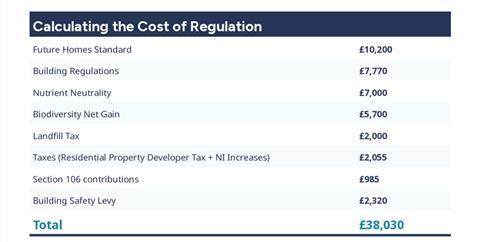
“The position has become circular. We are taxing development to raise much needed income for environmental and social considerations that we all agree are important, and as a result then having to subsidise the sector to deliver the homes we need.”
The report recommends a freeze on new regulatory burdens for three years.
It also says a two-part test should apply to every existing and proposed planning and regulatory obligation on new housing.
The first test is whether it is reasonable to impose the cost on new housing or whether the taxpayer should be funding it. It says nutrient neutrality, for example, is “the clearest failure of this test” as the issue it is trying to solve “has nothing to do with housing.”
The second test is whether the burden is proportionate for the benefit the policy going to deliver.
It said: “The Future Homes Standard should therefore be reviewed and amended to ensure the requirements are proportionate and far greater focus relating to energy efficiency should be directed towards the existing stock, where both the environmental impact and therefore the environmental gains from action are far greater.”
The report proposed section 106 should be narrowed to a “genuine, site-specific mitigation and it said its use “as a general funding mechanism for affordable housing, schools, healthcare or public services” should be restricted.
It also called for a pilot of community land auctions, a new shared equity scheme for first time-buyers, measures to speed up planning including the establishment of a new National Planning Service and a review of the green belt. Since the report has been drafted ministers have announced an equity loan scheme for first time buyers.
It said mayoral development corporations should be the default vehicles for new towns and large sites and called for mayors to be able to set them up more easily. Other recommendations include the £39bn Social and Affordable Homes Programme, resourcing Homes England’s National Housing Bank to offer competitive finance to smaller builders and to consider replacing stamp duty with a property tax.
Lord Barwell, in the report’s foreword said: “Many schemes with planning permission are currently unviable. It is much more expensive to build a home than it was five years ago - partly because of general inflation, but also because of government policies like the Future Homes Standard, nutrient net neutrality and biodiversity net gain as well as increases in employers’ national insurance contributions - but house prices have barely increased, wiping out developers’ margins.
“If housebuilders can’t make money from building schemes, we should hardly be surprised if those schemes don’t get built.”
The commission’s members, serving in a personal capacity, were Lord Barwell (chair), David Gauke, András Kárpáti, Tim Collins, Lucian Cook, Richard Cook, Trevor Ivory, James Knight, Jackie Sadek, Emma Duncan, Tim Leunig and Mark Prisk.







No comments yet