



Centre for Cities urges planning policy changes to close ‘density gap’
The UK must reform planning policy to enable the redevelopment of low-rise neighbourhoods built post-war if it is to densify its biggest cities, says the Centre for Cities.
A new report published by the think tank has found that such low-density schemes, built between 1950 and 1996, account for nearly half of all housing within one and two kilometres of the centre of Manchester, Birmingham, Glasgow, Liverpool and Leeds.
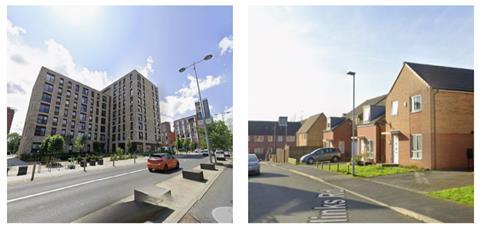
Development in these areas after 1945 was typically dominated by slum clearance programmes, which aimed to tackle overcrowding and unsanitary housing conditions, with spacious, low-density estates being built around the urban core.
The report documents how this trend of low-density construction continued in the later part of the 20th century as de-industrialisation reduced demand for urban housing.
“While these very low-density estates are an understandable response by local authorities trying to bring people into areas still blighted by bomb-damage, cleared slums and deindustrialisation, they now present challenges for policymakers seeking to increase the number of people who can live near city centres,” it said.
Centre for Cities estimates that post-war developments are typically 40% less dense than pre-war developments in similar locations, which it said meant fewer residents can access city-centre jobs than in similar urban centres across the world.
This “density gap” with similar cities in France and Japan is equivalent to around 2.3 million homes, according to the organisation.
It urged the government to further reform the planning system to be “more spatial and rules-based” and to invest in a City Densification Fund to help mayors unblock regeneration.
“Government is right to make a plan to densify large cities. Neighbourhoods close to city centres need more homes – including a mix of new flats and houses – to support urban living, transport investment and economic growth,” said Ant Breach, director of policy and research at Centre for Cities.
“Denser cities have larger labour markets and higher productivity potential. Redeveloping low-density neighbourhoods in big cities like Manchester, Birmingham and Leeds would add new homes with access to good jobs and opportunities those cities generate.
“Plans for ‘New Town’ urban extensions and funding for urban regeneration will help, but they should be part of a wider policy plan to accelerate urban densification across all suitable sites in big cities.”
The report found that more recent development had typically followed post-war density levels, except in the centre of big cities, and on the fringes of London, where significant densification has occured.
Full list of recommendations
- Amend the NPPF to require spatial development strategies to identify the city’s urban core
- Have these strategies target clear uplifts in density, particularly in well-connected areas
- Introduce to the NPPF an expectation for city councils to set out policies for intensification using rules-based planning tools
- Increase funding for local planning teams
- Reform biodiversity net gain requirements on brownfield flats and minimum space standards on one-bedroom flats
- Increase the use of local and mayoral development orders






No comments yet