



More than half of social landlords reported a reduction in rent arrears over the past year
The tenant arrears rate for social landlords as of 31 March was at its lowest level for at least four years, according to Housemark’s latest survey.
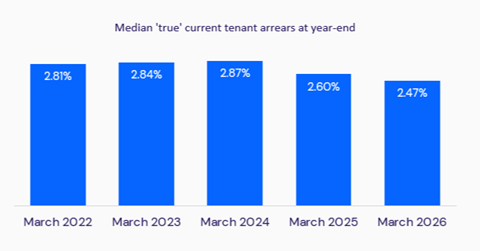
The data company’s March 2026 Monthly Pulse report showed a median ‘true’ tenant arrears rate of 2.47% - the lowest since the reports began in 2022. This figure was also down on the 2.6% reported in March 2025.
Provider responses to arrears seemed to improve, with 57% of the 161 social landlords who participated in the survey reporting a reduction in arrears over the past year ‘True’ arrears exclude sums disputed or under review.
The report also sought data on how landlords are responding to Awaab’s Law, which came into force in October 2025. Providers recorded a mean average of 83% of new emergency hazards reported per 1,000 homes in March, with an average of 92.9% of these being resolved within 24 hours.
According to Housemark, many landlords could only report on damp and mould emergency hazards, despite government guidance stating that phase one of Awaab’s Law includes all emergency hazards.
Following an initial grace period, Housemark said it now removes data from Pulse unless it meets the legislation’s phase one requirements. As a result, the average volume of emergency hazards in the sector has increased to a more representative figure.
Jonathan Cox, chief data officer at Housemark, said the increasing level of reported hazards reflects “better identification and more robust data rather than worsening conditions.”
Meanwhile, the median re-let time for March 2026 reached 51 days, down one percentage point from the previous month, while the annual average sat at 47 days, up from 45.7 compared to 2024/25.
Median customer satisfaction with overall landlord services sat at 77% in March 2026, down 4.3% from March 2025.
Housemark is jointly owned by the National Housing Federation and the Chartered Institute of Housing. It was established in 1999 and has around 350 member organisations across housing associations, local authorities and ALMOs in the UK.






No comments yet