



Sponsored by STEICO, this module looks at how to ensure retrofits and new-builds deliver “healthy” indoor enviroments. It then focuses in detail on how wood fibre insulation can help create indoor spaces that are sustainable and safeguard occupant health
In recent years, sustainability, energy efficiency and carbon reduction have become central priorities in the built environment. However, experience has shown that improving energy performance alone does not guarantee “healthy” indoor environments. Problems such as condensation, mould growth, poor indoor air quality and overheating have emerged where building fabric upgrades have been poorly designed, insufficiently coordinated or badly installed.
This module looks how it can be possible to deliver “healthier” indoor enviroments in practice, focusing on ventilation, moisture management, thermal comfort and overheating risk. It outlines relevant UK policy and regulatory context and highlights lessons from recent retrofit and new-build delivery failures. The module then considers wood fibre insulation as an option that can support the delivery of “healthier” enviroments within buildings.
Learning objectives
- Understand the key characteristics of a “healthy” indoor environment.
- Identify common causes of unhealthy indoor enviroments and explain how regulation and standards seek to address these.
- Learn how wood fibre insulation can contribute to ”healthy” indoor environments in appropriate assemblies.

What makes a “healthy” indoor environment?
”Healthy” indoor environments are those that support the health of those who occupy them – something that is particularly important today when we typically spend 80-90% of our time indoors.
When designing new buildings today designers consider a wide range of factors affecting occupant wellbeing, such as daylight, access to nature, accessibility and acoustics.
The term “healthy homes” is increasingly used as shorthand for a wider shift in priorities, as wellbeing has risen up the agenda and greater attention is paid to how factors such as air quality, overheating risk, daylight and comfort influence health and quality of life. Indeed, the government titled its new set of core specifications and good practice guidance on delivering healthier living environments, Healthy Homes (see below).
Voluntary certification schemes such as WELL, LEED and BREEAM all include measures that encourage ”healthier” indoor environments, particularly in terms of indoor air quality, thermal comfort, daylight and materials, with WELL centring health and BREEAM and LEED integrating health within broader sustainability frameworks.
The Healthy Homes agenda set by the Healthy Homes and Buildings All-Party Parliamentary Group also aligns closely with corporate ESG objectives because it links environmental building performance to social outcomes such as occupant wellbeing. Despite all this, the UK has, as yet, no single statutory definition of what makes a building “healthy” for those who occupy it.
Decent Homes Standard
Occupied domestic properties can be assessed using the Housing Health and Safety Rating System (HHSRS) and the Decent Homes Standard (DHS). The DHS is a legal standard that applies to social landlords and is designed to ensure homes are safe, warm and in a good condition. Homes must meet four criteria:
- Be free from serious hazards
- Be in a reasonable state of repair
- Have modern facilities and services
- Provide a reasonable degree of thermal comfort.
In 2025, the government consulted on reforms to the DHS, including the addition of a new criterion – that “damp and mould do not reach hazardous levels”.
At the same time, in recognition of widespread problems with damp, Awaab’s Law came into force introducing enforceable timescales for investigating and remedying damp and mould in the social-rented sector. Over the next two years the range of hazards covered by Awaab’s law will expand further, and the Renters’ Rights Act framework has given the government the power to extend those same duties and time limits to private landlords, meaning more properties will be legally required to be safe and ”healthy” for occupants.
In practice, particularly in the world of retrofit, the importance of getting three interlinked basics right has emerged as central to creating homes that are ”healthy” to live in. The three fundamentals are:
- Ventilation and indoor air quality
- Year-round thermal comfort
- Moisture control.
However, getting these basics right has consistently proven challenging – particularly in a policy environment that is moving the sector towards increased insulation and greater airtightness.
Ventilation
Controlled and adequate ventilation is essential to remove excess moisture and indoor pollutants, supply fresh air and help manage overheating. In more airtight buildings, reliance on window opening alone is generally insufficient as a ventilation strategy. Current standards and regulations – including Approved Document F (ADF) – demand designed, controllable ventilation systems that deliver predictable air-change rates year round.
Older buildings often rely on adventitious ventilation through draughts. While this can introduce fresh air, it is uncontrolled, undermines thermal comfort and conflicts with energy-efficiency goals. Best practice is therefore to reduce unintended air leakage while providing appropriate background and extract ventilation.
Ventilation may be provided through:
- Passive measures such as trickle vents
- Active mechanical extraction, by means of, for example, continuous or intermittent extractor fans in kitchens, bathrooms and wet rooms
- Whole-house mechanical ventilation with heat recovery (MVHR).
Well-designed systems should operate unobtrusively, removing moisture-laden and polluted air without relying on occupant intervention. Even well-designed systems can fail if they are not properly commissioned and explained to occupants. Inadequate commissioning of ventilation systems, poorly set controls or unclear handover information can undermine indoor air quality and thermal comfort. Post-completion testing and simple, intelligible user guidance can play a significant role in closing the gap between design intent and lived performance.
Volatile organic compounds
Ventilation plays an important role in improving indoor air quality by venting volatile organic compounds (VOCs) as well as getting rid of excess moisture. VOCs are carbon-based chemicals that evaporate at room temperature and are easily inhaled. They are emitted by many everyday materials and activities, including paints, adhesives, new furniture, cleaning products and combustion sources such as gas cooking, candles, wood burners. Short-term exposure can cause eye/nose/throat irritation, brain fog and fatigue, while long-term exposure to some compounds is linked to worsening asthma and other respiratory problems. Some VOCs are even carcinogenic with prolonged high exposure.
Indoor air can be several times more polluted than outdoor air, particularly in poorly ventilated spaces. As buildings become more airtight, ventilation design and material selection become increasingly important to maintain acceptable indoor air quality. UK health bodies offer advisory guideline values for VOC levels. NICE has advice for architects and designers on how to improve indoor air quality, which recommends a whole-building approach to heating and ventilation, balancing indoor air quality with standards for energy use.
Thermal comfort and overheating
Fabric performance is central to both energy efficiency and occupant comfort. Insulation reduces heat loss, lowers energy demand and helps maintain stable internal temperatures in winter. However, thermal comfort also requires consideration of summer conditions. Overheating poses serious health risks, and climate projections indicate that overheating risks may increase significantly in the UK over coming decades. The Chartered Institute of Housing (CIH) in its UK 2025 Housing Review cited evidence that shows how extreme climate change will affect UK homes in the future and highlighted the connections between climate change, health and housing. The CIH proposed a Futureproofing Homes Fund based on the DHS, under which a home could only be classified as decent if it is sufficiently resilient to overheating.
Overheating risk depends on a range of interacting factors including solar gain, glazing, shading, ventilation, thermal mass and occupant behaviour. These factors must be considered together rather than in isolation. A recent Committee for Climate Change (CCC) report suggested a range of packages of measures that can help prevent overheating. These include: external shutters, blinds, roof insulation, low g-value windows or window film, ceiling fans, solar reflective walls and active cooling.
Modelling studies have shown that roof insulation often reduces overheating risk, while wall insulation can increase risk in poorly ventilated homes but is beneficial where adequate ventilation is provided.
Moisture management
Damp and mould remain among the most common causes of unhealthy housing conditions and can pose significant risks to health. They mainly impact the lungs and airways, however they can also irritate the eyes and skin.
Moisture can enter buildings as rising damp; through cracked and damaged walls; or where gutters are overflowing onto the outside of brickwork. Such faults should be picked up during a physical survey of a property, and remedial work carried out to fix the root cause. It is important to remember too that moisture is also generated internally through normal activities such as cooking, bathing and drying clothes.
Condensation occurs when warm, moist air comes into contact with cold surfaces, creating conditions that support mould growth. Reducing this risk requires:
- Limiting moisture ingress
- Minimising cold surfaces and thermal bridges
- Providing adequate ventilation.
Correct insulation design and installation can help raise internal surface temperatures and reduce thermal bridging.
Best practice for moisture control is set out in standard BS 5250: 2021 Management of moisture in buildings, which emphasises understanding vapour movement, drying potential and material interaction within the building envelope.
UK housing
In recent decades, in the context of the move towards a whole new style of more sustainable construction that favours increased thermal efficiency and greater airtightness, ”healthy” home basics of thermal comfort and lack of damp have proven difficult to deliver – even in new-builds.
According to the Building Research Esablishment (BRE), around one in 10 UK homes is classed as poor quality and health impacts of poor housing cost the NHS £1.4bn a year. Recent research from Health Equals, the UK’s campaign to improve health inequalities, meanwhile, found 28% of those interviewed reported living in homes with damp, mould or cold. (It is important to note that fuel poverty will play a part in a statistic like this, as well as building design and maintenance.)
A good indication of the current state of English housing stock can be found by looking at the English Housing Survey (EHS). This judges homes against DHS criteria, but it covers all tenures and building types not just stock owned by social landlords. EHS data showed that the proportion of households living with damp in 2023/24 had risen to 5%, equating to around 1.3 million households; and the proportion of households reporting they had trouble keeping warm, was 13% (around 3.2 million households).
The EHS does not currently report on summer overheating, but analysis for the CCC report suggests that around half of homes in England are currently at risk of overheating, and, if global temperatures were to rise by 2°C, this number would rise to 90%. Overheating poses a serious threat to health and wellbeing, with potentially dangerous consequences.
Alongside regulatory reform, government policy has increasingly focused on improving the energy efficiency of existing homes through large-scale retrofit. The new Warm Homes Plan, which aims to upgrade millions of homes and tackle fuel poverty, reflects this emphasis on insulation and fabric performance. However, experience from previous retrofit programmes has shown that energy-efficiency measures delivered in isolation can increase risks relating to ventilation, moisture and overheating. This underlines the importance of integrating indoor environmental quality considerations into retrofit policy and delivery.
Building regulations and health
The main regulations governing the indoor environment of buildings are still building regulations. The following approved documents are particularly relevant:
- Part L – The conservation of fuel and power
- Part F – Ventilation
- Part O – Overheating.
As we have seen, these elements are closely linked, with changes to airtightness and U-values affecting ventilation requirements and overheating risk. Where these interactions are not fully considered, unintended consequences can arise. Compliance with building regulations is not enough on its own to ensure ”healthy” living environements.
Why problems persist
Various factors have come together at this point in time to mean unhealthy indoor environments remain common, despite the regulations. As some previously common problems have decreased thanks to the wider use of central heating, the moves toward increased airtightness and extra insulation have generated new problems – as have other contemporary issues such as fuel poverty, overcrowding, climate change and change of building use.
Lack of joined-up regulations
UK regulations have not been sufficiently aligned to ensure that the required joined-up, whole-house approach is always taken. Having developed piecemeal over time, the various parts of building regs are disjointed. So, for example, amendments to Part L and F are rarely carried out at the same time, while Part O has only been an approved document since 2022. And this disconnection has not promoted the holistic approach necessary to achieve successful results – and buildings that are ”healthy” for occupants.
Lessons from retrofit delivery failures
In 2025, the National Audit Office (NAO) reported major quality failures in recent insulation retrofit programmes delivered under government-backed schemes. Large numbers of external and internal wall insulation installations were found to have significant defects requiring remediation. The NAO highlighted skills shortages, suspected fraud and weaknesses in oversight as being behind the problems. For designers, the central lesson is that isolated measures increase risk. Insulation installed without proper assessment of ventilation, moisture dynamics and detailing can worsen conditions rather than improve them. ”Healthy” outcomes require a whole-building retrofit strategy, supported by competent assessment, design and quality assurance.
Performance gap in new-build
New buildings have not been immune to issues. From the late 1990s, research by the Zero Carbon Hub and others revealed that the energy performance of many new buildings fell well short of what had been expected at design stage. This widespread problem, known as the performance gap, has a range of causes including:
- Design assumptions versus real life
- Poor detailing and thermal bridging
- Skills gaps and poor workmanship
- Fragmented responsibility
- Airtightness and ventilation mismatch
- Commissioning and handover failures
- Value engineering and late changes
- Lack of feedback and post-occupancy evaluation
- Tick-box policy and compliance culture.
The performance gap has made many new buildings less ”healthy” than they might have been expected to be.
In an attempt to deal with problems such as these – and deliver more homes that support occupant health – parts of the building regulations have been under review.
Future Homes and Buildings Standards
The Future Homes and Buildings Standards (FHBS), just published in March 2026, aim to reduce carbon emissions from new dwellings by around 75–80% compared with homes built to the 2013 Part L standards.
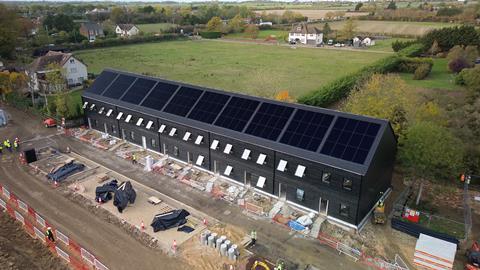
Compliance with Part L will continue to be assessed using the notional dwelling method, but the new notional dwelling specification includes low-carbon heating and on-site renewable electricity generation. In practice, this will usually be met through the installation of solar panels, typically covering an area equivalent to around 40% of the dwelling footprint, although flexibility is allowed where this is not technically feasible. As a result, most new homes are expected to include solar PV.
The new notional dwelling also assumes improved airtightness, with a target air permeability of around 3 m³/(h·m²). This is likely to push new housing towards continuous air barriers and mechanical ventilation systems such as mechanical ventilation with heat reclaim (MVHR). FHBS does not mandate mechanical ventilation systems. However, the combination of improved airtightness, energy efficiency requirements under Part L, ventilation requirements under Part F and overheating requirements under Part O means that mechanical ventilation systems are likely to become more common, as they can provide the required ventilation rates while minimising heat loss and helping achieve energy targets.
FHBS does not significantly tighten fabric performance compared with the 2021 Part L uplift, as much of the improvement in fabric standards was delivered in the 2021 changes.
Another major change under FHBS is the planned replacement of the Standard Assessment Procedure (SAP) with the Home Energy Model (HEM), a more detailed hourly simulation model that is better able to represent heat pumps, solar PV, battery storage and smart energy systems. In the interim an updated SAP 10.3 will be used.
One motivation behind the introduction of the FHBS was a desire to close the performance gap. While many of the operational performance measures in the revised Approved Document L – such as building logbooks, metering and operational energy information – are primarily aimed at non-domestic buildings, FHBS also includes measures intended to reduce the performance gap in dwellings. These include airtightness testing, improved modelling through HEM, commissioning of heating and ventilation systems, improved treatment of thermal bridging, and the provision of information to homeowners on how to operate building services. Together these measures are intended to reduce the difference between predicted and actual energy performance in new homes.
FHBS will come into force in March 2027, followed by a 12-month transition period.
New ”Healthy Homes” guidance
To supplement building regulations, in November 2025 the government published Healthy Homes – a foundation for healthy and resilient communities. This is a set of core specifications and good-practice guidance to be used by Homes England when funding, commissioning, and designing new homes, to support the delivery of ”healthier” living environments. There is advice on how to go beyond building regulation compliance to design ”healthier” homes. The core ”healthy-homes” targets for new builds are as follows:
- Accessibility – all new homes to meet the M4(2) standard of accessibility in Part M of building regs.
- Internal space standards and ceiling heights – all homes to comply with the nationally described space standard.
- Drying space – all homes to identify a dedicated outdoor or indoor facility for drying clothes.
- Outdoor amenity space – all homes to provide a private outdoor space such as a balcony, terrace, or garden.
- Outdoor storage – at least one cycle storage space should be as easy to access as the car parking provision.
- Dwelling frontage – no ”reds” under Building for a Healthy Life guidance, the companion guidance on designing ”healthy” neighbourhoods.
- Building fabric and energy performance – all homes to meet EPC A rating.
- Upfront embodied carbon – carry out a whole-life carbon assessment (WLCA) for both homes and wider development infrastructure following RICS WLCA, version 2, 2023.
- Aspect and/or views – all homes to be dual aspect wherever possible. At least one habitable room to receive direct sunlight during the daytime.
Design principles for good indoor environmental quality
The goals of sustainability and creating buildings that sustain health are not inherently incompatible. It is perfectly possible to design buildings that are both sustainable and “healthy” to live in. Several key principles can be taken from recent experience to inform the design of homes that offer good indoor environmental quality:
- Insulation is not a ventilation strategy; airtightness improvements must be coordinated with ventilation provision.
- Moisture risk must be assessed, not assumed; follow BS 5250 and whole-dwelling retrofit approaches such as PAS 2035.
- Detailing and installation quality dominate outcomes, particularly at junctions and penetrations.
- Occupant understanding and commissioning matter.
- Material choice supports performance but does not guarantee it.
The role of insulation
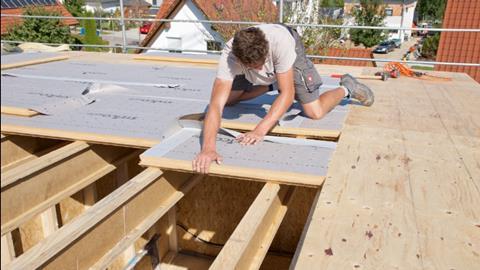
Insulation is a prerequisite for both energy efficiency and thermal comfort. When correctly designed and installed, and combined with suitable membranes and ventilation, insulation can reduce heat loss, raise internal surface temperatures and help minimise condensation risk.
Wood fibre insulation is one option that can support ”healthy” indoor enviroments in appropriate contexts.
What is wood fibre insulation?
Most wood fibre insulation products are manufactured using a process that begins with fresh, coniferous softwood sourced from PEFC (Programme for the Endorsement of Forest Certification) certified forestry. The wood is broken down into individual fibres using a combination of steam and mechanical treatments. These processes soften the lignin, the wood’s natural glue, which later helps bind the fibres back together to make a range of different insulation products.
The fibres are formed into various types of insulation, such as rigid boards, flexible batts and air-injected loose-fill insulation. Few additives are required, typically fire retardant, hydrophobic agents (paraffin or wax so the boards resist liquid water but remain diffusion open), and a light binder (for flexible boards and batts).
Wood fibre insulation is suitable for different types of construction:
- New builds – in new builds, wood fibre can be used in different forms to insulate walls, floors and roofs. Rigid wood fibre boards are suitable for roofs; flexible wood fibre batts fit between rafters or joists. In some new-build constructions, air-injected wood fibre in timber-frame wall panels is the preferred insulation.
- Prefabricated panels – air-injected wood fibre insulation can be blown into panels off-site in controlled factory conditions. This ensures all the voids in the panels are fully insulated, helping to reduce thermal bridging. The use of pre-filled panels reduces the labour normally needed to insulate between timber frameworks constructed on site.
- Retrofits and refurbishments – joists and rafters need flexible insulation that fits tightly to reduce gaps and thermal bridging. Solid walls require rigid insulation boards on the outside, which can then be rendered for weather protection. Where internal wall insulation is needed, this can either be installed using direct-fix rigid boards or flexible insulation batts between timber studs. All these are possible using wood fibre insulation. When retrofitting heritage buildings built from diffusion open materials, it can be helpful to specify diffusion open insulation to help maintain the building’s original moisture dynamics.
Wood fibre insulation has several qualities that make it well suited to contribute to the creation of ”healthy” homes.
A diffusion open material
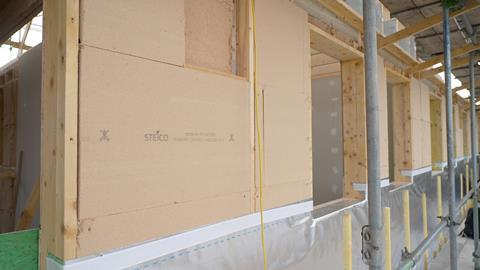
One of its important qualities is the fact it is a diffusion open (vapour open) material. This means it lets water vapour pass through by diffusion, unlike a diffusion closed material that does not and which acts as a barrier to moisture. It is important to note this term does not equate directly to breathable: it is about vapourdiffusion, not air movement. Airtightness and vapour diffusion are separate properties: a structure can prevent bulk air movement while still allowing water vapour to pass slowly by diffusion. This is why a wall can be airtight yet diffusion open, or air-leaky yet diffusion closed. Other examples of diffusion open materials include lime plaster and mineral wool. Both diffusion open and diffusion closed insulation can be used successfully in different contexts with appropriate detailing, membranes and ventilation.
Wood fibre insulation and indoor air quality
Because much wood fibre insulation is made from softwood fibres formed using heat, pressure and lignin (the wood’s own natural binder) with minimal additives, it is a naturally very low VOC-emitting product. (Batts made using the dry process may use 2–5% binder, usually PU or polyester.)
It is worth noting that in the UK (and EU), “low VOC” typically refers not to what level of VOC emissions a material gives off, but to its VOC content as measured in the wet product. Manufacturers can calculate VOC content from formulation data, and there is no requirement to test what actually off-gasses into indoor air. For this reason, makers of products with low VOC emissions often choose to get their products certified by one of the independent emissions testing certification schemes, such as that run by the Materials Institute for Building Biology in Rosenheim in Germany. Other independent certification schemes include Blue Angel, M1 and Greenguard. Many wood fibre insulation products are certified in this way.
Wood fibre insulation and moisture control
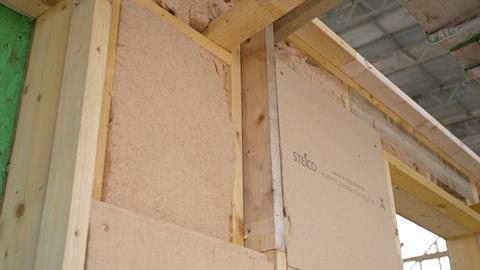
Wood fibre insulation can also help regulate internal humidity. A moisture management strategy that combines a vapour control layer (VCL) with wood fibre insulation can offer a robust and comparatively low-risk approach, particularly in retrofit and moisture-sensitive constructions. The VCL limits the amount of water vapour entering the building fabric by diffusion and air leakage, while the vapour-open and hygroscopic nature of wood fibre insulation allows any incidental moisture that does penetrate to be buffered and gradually dry outwards.
This supports controlled vapour movement and reduces the likelihood that moisture will accumulate to levels that promote condensation, mould growth or fabric decay. By contrast, diffusion-closed systems that rely on vapour barriers or impermeable insulation layers can be less tolerant of defects or unforeseen moisture ingress, as trapped moisture may be unable to dry, increasing the risk of long-term performance and durability issues if detailing or conditions are not ideal.
Wood fibre insulation and year-round thermal comfort
Wood fibre insulation can also help moderate summer overheating by slowing the rate at which external heat is transmitted through building fabric. Compared to many conventional insulation materials, wood fibre has a higher density and higher specific heat capacity, allowing it to absorb and store more heat energy and delay its passage into the interior. This thermal lag can help buffer daytime heat gains, so that peak external temperatures are less likely to coincide with peak internal temperatures, particularly when combined with effective ventilation and shading.
Lighter, lower-density insulation materials have lower heat storage capacity and can allow heat to pass through more rapidly, potentially increasing the risk of overheating in poorly ventilated buildings. In winter, good insulation also raises internal surface temperatures, improving thermal comfort at lower air temperatures and supporting reductions in energy use and associated carbon emissions.
As noted above, maintaining continuity of the insulation layer is critical to avoid cold spots where moist air can condense and mould may develop. Wood fibre insulation is available in dense, semi-rigid batts suitable for installation between timber studs, joists or rafters. When correctly cut and installed, these batts can be held in place by friction, helping to achieve a close fit that reduces gaps and supports insulation continuity. This can contribute to maintaining the thermal integrity of the insulation layer and reducing the risk of localised cold surfaces, provided it is combined with appropriate airtightness and vapour control detailing elsewhere in the construction. Designers must always consider practical constraints such as build-up thickness, detailing at junctions and overall cost when selecting insulation materials.
Wood fibre insulation and acoustic comfort
Thanks to its range of densities, wood fibre insulation can contribute to improved acoustic comfort by absorbing airborne sound within walls, floors and roofs. When used as part of a well-designed construction, this can help reduce noise transmission and reverberation, supporting a quieter indoor environment that benefits occupant health and wellbeing.
Wood fibre insulation and sustainability
As with all insulation materials, fire performance, detailing and compliance with relevant regulations must be considered as part of the overall specification.
Wood fibre insulation stores biogenic carbon absorbed during tree growth, which is reflected in environmental product declarations and contributes to its low embodied carbon. Depending on lifecycle boundaries and assumptions, this carbon storage can result in very low or, in some cases, net-negative global warming potential figures at the product stage.
At a time when sourcing is increasingly important, specifiers can choose wood fibre insulation made from timber sourced from sustainably managed woodland, which is certified as such by independent certification schemes such as PEFC.
In conclusion
There is a clear need to improve the ”healthiness” of indoor environments in both new-build constructions and existing building stock in the UK. While recent policy has focused strongly on energy efficiency and carbon reduction, experience has shown that an integrated approachis necessary to delivery ”healthy” indoor environments too. With appropriate design, detailing, installation and operation, it is perfectly possible to achieve this alongside pursuing sustainability goals. Insulation – including wood fibre insulation in suitable contexts – can play a supporting role, but success ultimately depends on whole-building thinking and competent delivery.
Please fill out the form below to complete the module and receive your certificate