



Reform UK deputy leader challenged on controversial allocation policies
The deputy leader of Reform UK told an industry audience that social housing was an “absolute privilege” this morning, as he defended his party’s recently announced allocations policies.
Speaking at the Housing Community Summit conference in Liverpool, Richard Tice spoke about the original intention of subsidised housing after the Second World War in response to a challenge from the session’s chair over the party’s “problematic” proposal to evict “foreign nationals” from social homes and prioritise married couples over single-parent families on waitlists.
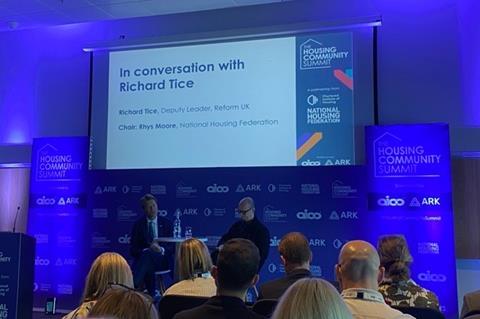
“If you go back to when council housing was originally established post the Second World War under the Labour government, there were very, very strict conditions around who would qualify and how they looked after the housing […] it was a privilege, an absolute privilege to be given a council house,” said Tice.
“I think that there is always a big debate around prioritisation on the waiting list. Until we build a lot more, then we’ve got to say, have we got it right? Is it fair at the moment?”
There were several challenges to the party’s allocation policies from the panel’s chair, Rhys Moore, executive director of public impact at the National Housing Federation, which is hosting the conference in partnership with the Chartered Institute of Housing (CIH).
Audience members also pushed back on the party’s housing policies, with Nic Bliss, campaign director at Stop Social Housing Stigma, highlighting that 70% of tenants reported feeling stigmatised living in social housing in a survey last year.
Meanwhile, Mike Kirk, chair of The Hyde Group, said Reform’s evictions policy is “sowing discontent in our communities now when we need social cohesion, not social separation, based on information which is frankly misleading on things like the existing policy that [housing providers] have on allocations”.
During the session, Tice also restated his party’s stance on deregulating the development environment, arguing that slashing affordable housing requirements from 30% to 5% in major cities is “basic maths [because] 30% of nothing is nothing”.
He emphasised Reform UK’s desire to create a sovereign wealth fund, announced earlier this year, to unlock “£30bn to £50bn pounds for affordable social housing” and said that homes should be valued at market value subject to tenancy (MV-STT) on housing association balance sheets - an idea outlined in a party document published last week.
In response, Kirk said 125,000-home Hyde already has “some of our loans on existing market value subject to tenancy and I don’t think that gives you significant additional capacity”.
Tice’s appearance at the event was not without controversy, with some criticising the decision to give him such a prominent platform. In a post to LinkedIn, the organisers defended the decision, explaining that “invitations were extended to housing spokespeople from all the major political parties, but not all were able to attend”.
“The session with Richard Tice is not intended to provide an unchallenged platform. Given the significant impact that housing policy has on residents, organisations and communities, we believe it is important that delegates have the opportunity to hear from and scrutinise representatives from across the political spectrum. The aim is to create space for open debate and challenge, not endorsement.
“We appreciate that views will vary on engagement with political parties and welcome the challenge as we endeavour to strike the right balance,” the Housing Community Summit wrote.






No comments yet