



But sector bodies say Swinney’s bold housing goals lack detail
Scotland’s first minister has promised to end the use of “unsafe and harmful” temporary accommodation for children and re-iterated his pledge to build 111,000 affordable homes by 2032.
John Swinney, leader of the Scottish National Party, delivered his programme for government 2026-2031 to the Scottish Assembly on Tuesday, setting out a vision for public service modernisation which he said would mark “a decisive shift to prevention and early intervention”.
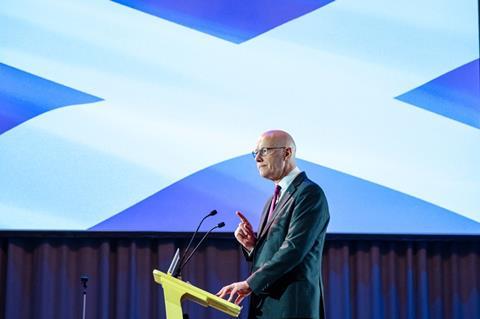
For housing, he said, this means the continuation of support for first-time buyers, worth up to £10,000, the continued roll-out of the £50m homelessness prevention fund, and £2m to support its partner Social Bite’s village project.
The first minister said that at least 70% of affordable homes delivered by 2032 would be available for social rent.
“Our ambition, and our intention, is that more people in Scotland get a home that they can afford,” he said.
The pledges have received a cautious welcome from the housing sector, with a side order of scepticism at the government’s ability to deliver.
Gordon Llewellyn-MacRae, interim director at Shelter Scotland said Swinney’s temporary accommodation announcement was “good news”, but that “promises alone won’t cut it any longer”.
“Last year he promised to build 8,000 affordable homes – it didn’t happen,” he said.
“Now, a year since the Scottish Government published its Housing Emergency Action Plan, we still don’t have a credible plan to deliver the social homes that can actually lift people out of homelessness. So he will understand why we will hold off the celebrations until the urgent change we need is a reality.”
Llewellyn-MacRae added that Swinney now needed to “back up good intentions with action”.
CIH Scotland national director Gillian McLees agreed that the success of the programme would be “determined not by ambition alone, but the detail that sits behind the plan” and said the CIH would “welcome further information and detail”.
She also noted that, despite repeating his ambition to deliver 110,000 affordable homes, Swinney had “provided little detail of how these new homes will be delivered”, despite evidence the government was “falling significantly behind its own target”.
McLees added that CIH Scotland “agree fully” with the plan to reshape public services to focus on prevention and early intervention, saying that “the housing sector has demonstrated time and time again the value of prevention”.
“Investing in homes and housing services improves people’s health and wellbeing, keeps people out of hospital and residential care and allows people to live independently in communities for longer,” she said.
“Stable housing helps people to put down roots, build social connections and develop resilience. It improves people’s lives and it saves money.”
CIH Scotland also welcomed other measures in the programme, including a commitment to tackle violence against women and girls, funding to support third sector services and the Fund to Leave, and the commitment to introduce the heat in buildings bill, which was delayed during the last parliamentary term.
The bill is intended to scale up heat networks and support clean heating and energy efficiency measures, with the aim of lowering emissions and costs for 100,000 properties.
Meanwhile, development body Real Estate:Scotland, welcomed another measure announced in the programme.
Swinney promised to create a new major projects office to accelerate progress on nationally and strategically significant infrastructure investment, with a particular focus on housing and energy.
“The creation of a Major Projects Office as part of the Programme for Government is very welcome move and could result in a transformational change in economic performance across Scotland by unlocking significant strategic developments across Scotland to bring much needed jobs, economic growth, and housing,” said David Melhuish, director for Real Estate:Scotland.
“However, to fully maximise the opportunity afforded by its creation, the government needs to urgently understand and address the development viability challenge currently affecting key strategic sites and development more generally across Scotland, as well as work to improve the planning system to reduce unnecessary delay and uncertainty.”



No comments yet