Planning Inspectorate throws out 110-home Glassmill scheme following two-year campaign by locals and celebrities
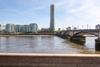
Rockwell’s plans for a 29-storey tower at the southern end of Battersea Bridge have been dismissed at appeal following a campaign led by celebrities including Mick Jagger and Eric Clapton.
The Planning Inspectorate issued its decision on the controversial 110-home Glassmill scheme, designed by Farrells, last Thursday.
It comes a year after Wandsworth council resoundingly refused the 100m-tall tower due to concerns over its height compared to the surrounding mid-rise area on the eastern side of Battersea Park.
Rockwell, the scheme’s developer, wrote to the government in April ahead of the Planning Inspectorate’s decision being issued to request that the appeal should be recovered for determination by communities secretary Steve Reed.
However, it has been confirmed that the appeal will not be recovered, ending Rockwell’s hopes to salvage its plans for a project which has faced sustained local opposition since first being submitted in April 2024.
Farrells was appointed as lead architect in 2022 with late practice founder Terry Farrell, who died last year, said to be closely involved in designing the scheme during its early stages.
Originally proposed as a 36-storey tower with a 13-storey shoulder block during pre-application discussions, the scheme was trimmed to 34 storeys for its full application before being cut again to 29 storeys with a 20-storey shoulder block in October 2024.
These amendments proved unable to stem a tide of dissent from the general public with the application amassing more than 2,000 objections by the time of its planning committee date and two petitions signed by a total of 6,000 people calling for the tower to be scrapped.
Those fighting the scheme included Mick Jagger, Eric Claption, Felicity Kendal and Anthea Turner.
Jagger, who has been a resident of the northern bank of the river for more than six decades, told the Chelsea Citizen in March that the proposals were “totally wrong on every level” and risked “changing this wonderful stretch of the Thames riverside for ever”.
The scheme was also consistently lambasted by heritage groups during its planning process with Historic England dismissing its height reductions as insufficient to prevent the visual impact of the tower on nearby heritage assets.
In its appraisal of the final proposals the heritage body described the scheme as “visually intrusive and incongruous addition to the townscape with wide reaching harmful impacts on the historic environment”.
Planning inspector Joanna Gilbert made four unaccompanied visits to the site in February and March this year and visited Hyde Park in April to assess the tower’s impact of protected views.
While Gilbert said the plans would provide public benefits including market and affordable housing, she said she “afforded very substantial weight to the adverse effects on the character and appearance of the area”.
Gilbert concluded that the scheme would breach the London Plan and Wandsworth’s local plan, which had redefined the site in 2021 as suitable for mid-rise schemes only, negating a previous allocation for tall buildings.
Gilbert said: “The proposal would be contrary to the development plan taken as a whole, and there are no material considerations that indicate that planning permission should otherwise be granted.”
The project team includes DP9 on planning, Montagu Evans on townscape and heritage, Exterior Architecture as landscape architect, Velocity on transport, GIA on daylight, Ashton Fire as fire consultant and EOC as structural and civil engineer.


No comments yet