



Watchdog blames economic challenges and increased regulation for reduced activity
The Office for Budget Responsibility (OBR) has said it expects 190,000 fewer additional homes to be built over the 2025/26 to 2030/31 forecast period compared to its March 2026 prediction.
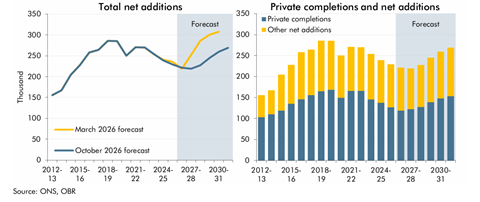
Published after today’s Budget announcement, the OBR’s economic and fiscal outlook document said it anticipates net additions to UK housing stock to fall from around 230,000 in 2025/26 to 220,000 in 2026/27 before rising gradually to 260,000 in 2030/31.
It also said it expects the ‘Your First Home’ equity scheme, which is aiming to support the delivery of an estimated 20,000 new homes, to “only have a marginal impact on housing supply given its limited overall size”.
However, the public finances watchdog maintained its position from March that the National Planning Policy Framework “would boost housebuilding significantly” on its own, but blamed economic pressures and regulatory changes over the past decade for its more pessimistic forecast.
Click here for more Budget 2026 coverage
It said higher interest rates and weak demand have dampened commercial viability, while building safety regulations, such as the Building Safety Levy, Building Safety Regulator regime and biodiversity net gain (BNG) requirements have increased the cost, complexity and timescales for housebuilding.
At-a-glance: Budget housing measures
- Reforms to ‘green book’ used by Treasury to assess business case for investing in projects - new guidance on developing place-based business cases which will mean housing projects can be considered together with other types of development
- Extra £1.5bn for the Social and Affordable Homes Programme
- New £4.7bn Your First Home equity loan scheme aimed at supporting 70,000 first-time buyers with up to 20% government equity loans
- Removal of BNG requirements on brownfield land up to 1.5 hectares
- Cheaper borrowing for councils for housing by extending the preferential Public Works Loan Board rate for a further year, to 2027-28, at 40 basis points below the PWLB normal rate
- Zero-rate of VAT for land sold to registered providers of social housing
- Flexible funding to invest in local authorities, boosted by £1.5bn of devolved loans for mayoral authorities - will back transport and regeneration projects
- Roadmap for fiscal devolution - 100% of business rates will be retained by end of the decade
- £100m local apprenticeship service funded from savings in welfare fraud and error
- White paper and legislation next year on reforming welfare system following Milburn report
- Further £430m for rough sleeping
- No changes to building regulations for the rest of parliament, except building safety
- The government will introduce a new First Time Buyer ISA from April 2029
Last month, housing secretary Angela Rayner admitted there is a “slim chance” the government will meet its target of building 1.5 million homes during this Parliament.






No comments yet