


New prime minister made similar pledge when elected Manchester mayor in 2017
Andy Burnham has pledged to end rough sleeping in his first speech as prime minister, echoing a promise he made in 2017 when he was elected mayor of Greater Manchester.
Burnham said the newly announced national policy would be the first order he would give to his government.
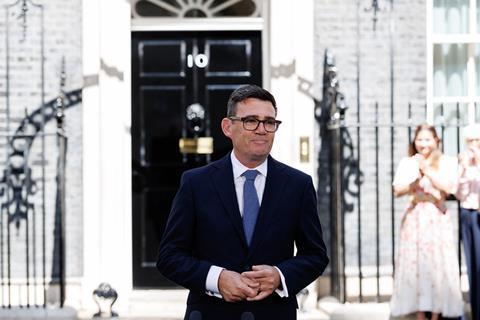
Speaking in front of Number 10 Downing Street today, he said: “I will soon go through that door behind me and issue my first instruction to end rough sleeping in our country. It’s about putting the right values and the right standards at the heart of government.”
Burnham pledged to end homelessness in Greater Manchester by 2020 when he was elected mayor of the combined authority in 2017 and donated 15% of his mayoral salary to a homelessness fund.
But while homelessness declined during his first two years in office he acknowledged in 2019 that the target would be missed.
Official figures, based on a ‘snapshot’ of a single night, recorded the number of people sleeping rough fell from 268 people in 2017 to 89 people in 2021 before rising after the covid pandemic, with a snapshot in 2025 finding 197 people sleeping rough.
As mayor, he launched the Bed Every Night Programme in 2018 which extended the offer of a bed to anyone in Manchester sleeping rough, including those who had been excluded under mandatory provisions offered by councils.
It also assigned support workers to people experiencing rough sleeping to provide them with guidance on finding permanent housing, accessing healthcare and mental health services, drug and alcohol treatment and accessing benefits.
The programme is funded through a combination of government homelessness grants, Greater Manchester Combined Authority funding, contributions from councils and charitable donations.
Burnham also reiterated his pledge to build more council housing in today’s speech, badging it as part of a plan to “build a more preventative state” which would invest in “people’s success rather than paying for failure”.
He acknowledged his entry into Downing Street as the seventh prime minister in just over a decade, admitting that the country’s rapid turnover of leaders “requires my generation of politicians to raise our game”.
“Britain needs to show the world that we can regain our stability once again, and that is our challenge: to make politics work, to make it work better,” Burnham said.
He added: “I know people at home are fed up with politics. I hear you, and I want to be honest with you. We have not been good enough, and we need to be better. We will be.”
He also repeated criticisms of deindustrialization policies taken by the Conservative party in the 1980s, describing them as “wrong turns” which had centralised political and economic power and left large parts of the country unable to escape decline.
In a speech last month prior to becoming prime minister, Burnham unveiled plans to create a new prime ministerial office in Manchester called “Number 10 North”, which would work to extend devolution to local and combined authorities across the country.
The office would also oversee the “biggest council house building programme since the post-war period” using vacant public land and higher density development to reduce costs, he said in June.
The new prime minister will unveil his cabinet over the next few days with the office of chancellor expected to be handed to either Ed Miliband or Shabana Mahmood.



No comments yet