


Ahead of the Housing Forum’s Yorkshire Housing Partnership Summit, Clarion’s Richard Cook explains how the 13-acre Dyecoats regeneration is combining 40% affordable housing, major public realm and social impact initiatives — and why large-scale schemes will not stack in today’s market without deep, long-term collaboration
Across Yorkshire, the pressure to deliver more homes is colliding with a tougher financial climate, tighter regulation and stretched affordability.
City leaders are under growing expectation to unlock brownfield land, scale up mixed-tenure delivery and demonstrate that regeneration can provide not just units, but infrastructure, jobs and long-term stewardship.

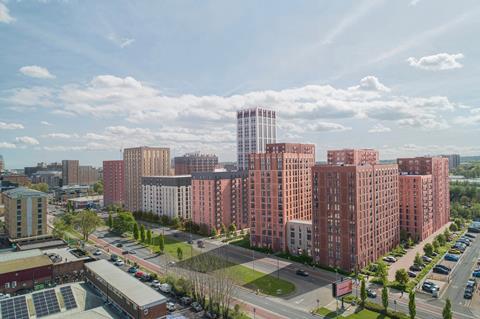
In Leeds, one of the region’s most significant urban extensions is attempting to do exactly that. Clarion Housing Group’s 13-acre Dyecoats scheme is reshaping a former industrial site on the River Aire into a high-density neighbourhood with 40% affordable housing, extensive public realm and embedded community uses.
But as Richard Cook, chief development officer, Clarion makes clear, its progress has depended on sustained partnership, patient capital and a willingness to rethink policy and product along the way — themes Clarion will expand on when he addresses delegates at the Housing Forum’s Yorkshire Housing Partnership Summit.
Rewriting the future of Leeds’ West End
Dyecoats sits on 13 acres of brownfield land by the River Aire, a short distance from Leeds station.
The site forms a critical part of the city’s westward expansion, as the commercial core shifts towards Wellington Place and Channel 4’s new headquarters. Together with an adjacent scheme, the wider Kirkstall Road corridor will deliver around 2,500 homes – kick-starting the regeneration of this stretch of the West End.
Clarion acquired the Dyecoats site in 2020, in the middle of the pandemic, with an existing planning consent already in place. But that consent reflected an earlier era of development.
“Fifty per cent of the site was parking,” Cook explains. “It was very car-led, very street-driven. The world’s moved on from that.”
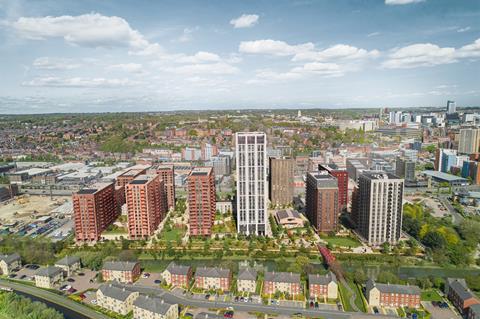
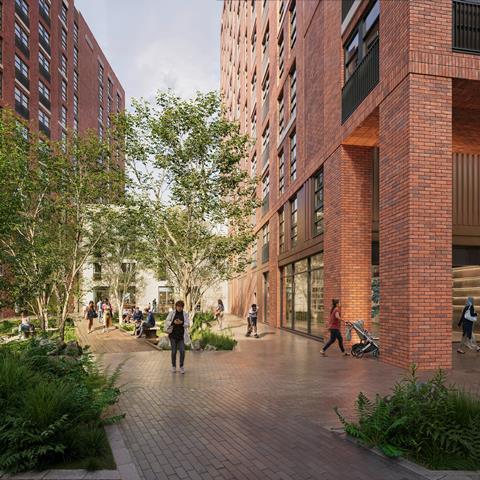
Clarion has since turned that model on its head. The revised masterplan delivers around 1,800 homes, half of which will be for affordable tenures, while 40% of the site is given over to public green space. Biodiversity net gain is running at around 800%, a dramatic transformation for a previously hard-surfaced industrial plot.
The message for summit delegates is clear: regeneration at scale must now mean more than housing numbers. It must embed sustainability, public realm and long-term stewardship from the outset.
A mixed-tenure neighbourhood – and a destination
Dyecoats blends private sale, build-to-rent and affordable housing in a single masterplan. The first 434 homes are now under construction, with completions due in 2027; half of those will be affordable.
Of those 434 units which are currently under construction there will be 100 social rent homes, 138 for shared ownership and another 196 for private sale.
But Cook is keen to stress that this is not simply a housing estate.
At the heart of the scheme will be around 6,000 sq ft of food hall, leisure and community space, designed to act as a focal point for the wider area. “It’s not just about housing,” he says. “It’s about creating a new community and a new sense of place.”
By delivering green space, leisure uses and infrastructure early – including a new north-south bridge installed at the start of the project – Clarion is seeking to ensure that connectivity and amenity are in place before the first residents move in.
The development is designed to be net-zero carbon compatible, fully electric and built to future homes standard principles, reflecting Clarion’s long-term ownership model and the decarbonisation of the grid.
Partnership as a precondition, not an add-on
For Cook, however, the defining feature of Dyecoats is not its scale or sustainability credentials, but the funding and delivery model behind it.
The affordable homes are supported through Homes England’s strategic partnership programme, while West Yorkshire Combined Authority has provided brownfield infrastructure funding. Without that layered public investment, Cook is blunt: the scheme would not stack.
“We’ve all got viability issues at present,” he says. “If we didn’t have the collaboration of Leeds, Homes England’s support and the Combined Authority putting funding in to deliver infrastructure, these things just would not happen.”
He points to Clarion’s parallel project at the former Boddingtons Brewery site in Manchester, which would deliver no affordable housing without similar partnership structures.
The advice to others looking to unlock comparable schemes is equally direct: start early, and be open.
“It’s early engagement. Continuous engagement,” he says. “You’ve got to start those conversations before you even buy the land.”
That includes frank discussions about viability. “Be very open with people. Be prepared for a long journey.”
At Dyecoats, the planning process was drawn out in part because Clarion was offering high levels of grant-funded affordable housing in a city-centre scheme – something relatively unfamiliar in Leeds. Building trust, Cook says, was essential.
“Sometimes the policy that is written down isn’t applicable to the type of project you’re trying to do,” he adds. Product mix must respond to operational reality as well as local need. A policy skewed towards small one-bed affordable units, for example, may not work in a high-rise setting if it creates long-term management challenges or concentrations of vulnerability.
For Cook, true partnership means not simply signing funding agreements, but taking councils and combined authorities on a learning journey.
Regulation, delay and the cost of doing the right thing
The scheme has also been reshaped by the post-Grenfell regulatory landscape.
Planning permission was secured in 2022, but as Clarion prepared to start on site, new legislation around second staircases and the move to the Building Safety Regulator (BSR) regime came into force.
Clarion chose to redesign the project to incorporate second staircases across the board. The result: a three-year delay.
“Between the legislation, the consultation, the redesign, going back to planning and getting approval through the BSR, that’s taken three years,” Cook says.
As a long-term asset owner, Clarion was determined to “do the right thing”. But the experience underlines how quickly programme risk can escalate on large urban schemes.
Beyond bricks and mortar
Dyecoats also incorporates a social impact initiative that Cook describes as central to the project’s legacy.
Working with Leeds-based homelessness charity St George’s Crypt, Clarion has invested more than £1m in temporary modular accommodation for rough sleepers. Nine modular units provide a stepping stone from the streets into stable housing, with wraparound support delivered by the charity.
In partnership with contractor Graham Construction, residents are also being supported into employment on the Dyecoats site itself.
“We’re trying to reset them off the streets, into housing and then into employment,” Cook says. After four years, the programme has achieved what he describes as a “high degree of success” and is being considered as a model for replication elsewhere.
For a housing association, he argues, regeneration must encompass this broader social mission.
A hard market – and a warning note
While government has committed to focusing on growth and delivery, Cook offers a note of caution about current market conditions, labelling them “significant”.
Affordability is “incredibly stretched”, including within Clarion’s substantial shared ownership programme. In its most recent quarterly update, the group reported sales revenue down 50% on the previous year. As a result, it has pivoted away from exposure to outright sale in the short term.
“We’ve got to be incredibly cautious around the levels of scale we take on,” he says. “The downside risk can inherently affect our businesses.”
That context makes partnership even more critical. Large, mixed-tenure schemes can still come forward – but only where risk is shared and public funding aligns with long-term stewardship.
A live test for Yorkshire
For delegates at the Housing Partnership Summit, Dyecoats offers a tangible case study. It demonstrates how brownfield land can be transformed into a mixed-tenure neighbourhood with strong sustainability credentials, embedded community infrastructure and a clear social mission.
But it also illustrates the conditions required for delivery: early and sustained collaboration, flexible interpretation of policy, patient capital and a realistic appraisal of market risk.
As Cook puts it, “These long-term projects need long-term partnerships.”
In Leeds’ West End, that principle is now being put into practice – with the first homes rising, the bridge already in place, and a new neighbourhood beginning to take shape.
Housing Partnership Summit for Yorkshire with Latimer by Clarion Housing Group
Join the Housing Forum in Yorkshire for a focused exploration of how partnerships, investment and innovation are reshaping the region’s housing future.
The Housing Partnership Summit for Yorkshire brings together leading voices from local government, national agencies, investors and developers to examine the forces driving housing delivery across the region.
Discussions will centre on the region’s evolving market dynamics, the funding models with the greatest potential to unlock scale, and the strategic collaborations needed to accelerate both new supply and the renewal of existing homes.
Participants will also gain insight into how major regeneration schemes, such as Clarion’s Dyecoats project, are setting new benchmarks for mixed‑tenure development, community infrastructure and long‑term place creation.
The afternoon concludes with lunch and the opportunity to see one of Leeds’ most significant regeneration sites first-hand.
PROGRAMME
10.00 | Arrivals and registration
10.30 | Welcome and Introduction
Alex Notay, Chief Executive, The Housing Forum
Michael Briffet, Latimer by Clarion
10.35 | The Yorkshire Housing Market in 2026 – (Presentation)
Marcus Dixon, Director, JLL
10.45 | Funding Housing Delivery for the Yorkshire Region - (Panel)
This session explores innovative funding models and partnership approaches to accelerate housing delivery across the Yorkshire region. Participants will examine current barriers, emerging investment opportunities, and practical strategies for unlocking and sustaining long‑term housing growth.
11.30 | Networking break
12.00 | Kirkstall Road: The Importance of Partnerships, Place making, and Community Building - (Presentation)
Michael Briffet, Latimer by Clarion
12.20 | Leeds South Bank - (Presentation)
Angela Barnicle, Director of City Development, Leeds City Council
12.40 | Lunch break
13.40 | Site tour of the Kirkstall Road scheme
15.00 | Close




1 Readers' comment